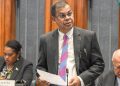
Fiji’s Parliament has questioned why a village relocation site built with a $2.7 million grant from a German non-governmental organisation still has no properly constructed roads, church, playground, farmland or community hall — and why the villagers living there cannot get a straight answer on how much of the money is left. The concerns were aired on Tuesday, 30 September 2026, during debate on the Public Accounts Standing Committee’s review of the Performance Audit on the Implementation of Climate Change Adaptation Actions in Fiji, FBC News reported.
Key facts
- The project is funded by a $2.7 million grant from a German non-governmental organisation, according to FBC News.
- The concerns surfaced on Tuesday, 30 September 2026, during Parliament’s debate on the Public Accounts Standing Committee’s review of a performance audit of climate change adaptation actions in Fiji.
- Committee members visited the relocation site and were briefed by residents there, Committee Chair Joseva Vocea told Parliament.
- Still outstanding, on Vocea’s account: properly constructed roads, a church, a playground, farmland and a community hall.
- Vocea said the committee found a lack of transparency and prolonged delays, and that villagers want FCOSS and the contractor to state how much of the grant has been spent and how much remains.
- Opposition Leader Inia Seruiratu said donors should consult government before entering such arrangements, particularly where funding and disaster support are involved.
- Fiji’s National Adaptation Plan sets out more than 160 climate adaptation actions across key sectors, FBC News reported.
- The report does not name the village, the relocation site, the German NGO or the contractor, and publishes no spending figure, remaining balance or completion date.
- No response from the Government, FCOSS, the contractor or the grant-maker appears in the reporting available at publication.
What the committee found
Vocea told Parliament that despite significant funding, the infrastructure the community was promised at the new site is not finished, FBC News reported. He said committee members were briefed by people in the village during a site visit and heard directly that the relocation site remains incomplete, with residents left waiting for the developments they were promised.
The specifics he relayed were mundane and material: roads still to be properly constructed, and a church, a playground, farmland and a community hall still outstanding. Those are not decorative extras in a relocated village. They are what makes a new site work as a settlement rather than a cluster of houses — moving produce and people in and out, growing food, and having somewhere to worship and gather. A relocation that stops at the houses leaves a community physically moved but socially and economically stranded.
Alongside the delays, Vocea said the committee identified a lack of transparency, and that the villagers’ own request is narrow and answerable: they want FCOSS — the acronym used for the Fiji Council of Social Services — and the contractor building the project to come clean on the finances, and to say how much of the money has been used and how much is left. On the reporting available, that question has no published answer. There is no acquittal of the grant on the public record, no breakdown of spending to date, no remaining balance and no revised completion date for the outstanding works.
The Opposition’s point
Opposition Leader Inia Seruiratu framed the problem as one of process at the front end of such arrangements. “They have to consult government before they go into these arrangements, particularly those that involve funding and other support when we have disasters,” he said, as quoted by FBC News.
Read against Vocea’s findings, that is an argument about sequencing rather than about goodwill. If consultation with government happens before a donor-funded relocation is signed, the reasoning runs, the standards, timelines and reporting obligations are fixed while there is still leverage to fix them — and there is a government agency on the hook to chase them. Once the money is committed and the houses are up, the only remaining pressure is reputational. The reporting does not record anyone contesting that point during the debate.
Where donor climate money is meant to show up
The funding route shapes what Parliament can and cannot see, and it is the reason a $2.7 million project could run late for some time before MPs debated it. Money appropriated in Fiji’s Budget is published in the estimates, debated line by line, spent through a ministry and then audited by the Office of the Auditor-General, whose reports are referred to the Public Accounts Committee. A grant made by a foreign non-governmental organisation to a project on the ground travels a different path: it is normally accounted for to the donor that provided it, under that donor’s reporting timetable, and it does not appear as a vote in the national estimates. On the reporting available, the committee’s way in here was not the Budget cycle at all but a performance audit review and a visit to the site.
Fiji does have a domestic machinery for exactly this kind of spending. The country endorsed planned relocation guidelines in 2018, set up a Climate Relocation of Communities Trust Fund in 2019 and has since adopted standard operating procedures for moving at-risk communities — a framework designed so that relocation costs are identified, sequenced and reported through government. The FBC News report does not say whether this project was assessed against that framework, or whether any ministry was formally party to it, and we make no claim either way. That silence is itself part of what Seruiratu was complaining about.
Nor can the sum be placed in proportion on the strength of this report. FBC News gives no figure for Fiji’s own adaptation spending, no total for donor climate finance flowing into the country, and no costing for the National Adaptation Plan‘s more than 160 actions — so $2.7 million cannot be read here as either a large or a marginal share of the national adaptation effort. What the report does establish is narrower and still consequential: for one village, the full amount of a single grant has been committed, the work is unfinished, and the people it was spent on cannot find out what is left.
Why it matters
Relocation is the sharp end of Fiji’s climate response. It moves whole communities, permanently, and it is expensive per household precisely because it has to replace roads, water, farmland and meeting places as well as houses. On the committee’s account, this project has stalled with residents still waiting on promised works, which makes it a test of oversight as much as of construction. Parliament, according to FBC News, says stronger coordination, accountability and oversight are needed so that vulnerable communities actually receive the intended benefits of relocation and adaptation projects.
The case matters beyond one village because the National Adaptation Plan runs to more than 160 actions across key sectors, many of which will be delivered with external money. If a single, externally funded relocation can run late and stay unclear on its accounting even under a parliamentary spotlight, the committee’s findings bear directly on how the rest of that pipeline is tracked — and on whether donors, government and communities can all see where the money lands. It is the same question of control that runs through Fiji News’s wider coverage of this beat, from the Fijian villagers who carried their relocation experiences to Pre-COP31 in Nadi to the argument that villages be treated as climate implementers rather than beneficiaries — that the communities being moved are the ones with the strongest interest in the accounts being straight.
Who has not responded
The report does not record a response from the Government or from the project’s implementers to either Vocea’s findings or Seruiratu’s remarks. It also does not state whether FBC News sought comment from the Government, FCOSS, the contractor or the German grant-maker before publishing, and no request for comment from any of them is on the public record. The parties best placed to answer the villagers’ single question — how much has been spent and how much remains — have not been heard from. Fiji News will update this report if any of them respond publicly or provide comment.
What happens next, and what is still unknown
The document at the centre of Tuesday’s debate was the Public Accounts Standing Committee’s review of the Performance Audit on the Implementation of Climate Change Adaptation Actions in Fiji. Reviews of this kind reach Parliament as committee reports and are debated on the floor, which is how these findings became public. FBC News does not set out the audit’s other findings, name its author, or say when it was completed or when the committee’s site visit took place.
Also unpublished: the identity of the village, the relocation site, the German non-governmental organisation behind the grant and the contractor engaged on the works; how much of the $2.7 million has been spent and how much remains; and when the outstanding roads, church, playground, farmland and community hall are due to be delivered. The source does not say whether any agency has been directed to report back to Parliament on the project, or by when. Fiji News will follow the committee’s next steps.
How we sourced this report
This account rests on FBC News’s report of Tuesday’s parliamentary debate, the only published account of the exchange available to us at the time of writing; no other outlet’s report, and no government, committee or FCOSS statement on the project, was available when this was published. The daily Hansard record for the sitting, which would carry Vocea’s and Seruiratu’s remarks in full and any government reply, was also not yet available to us, and we will check this report against it. Readers should treat the single-source details — particularly the $2.7 million figure and the unnamed parties — as FBC News’s reporting rather than independently verified fact; the background on Fiji’s relocation guidelines and trust fund is drawn from the government’s published policy framework, not from the FBC report. Corrections and on-the-record responses are welcome.
Frequently Asked Questions
What is still missing at the new relocation site?
Committee Chair Joseva Vocea told Parliament that villagers said they are still waiting for roads to be properly constructed, along with a church, a playground, farmland and a community hall, according to FBC News. He said committee members heard this directly from residents during a visit to the site.
What do the villagers want to know about the $2.7 million?
According to FBC News, Vocea said the villagers want FCOSS — the Fiji Council of Social Services — and the contractor building the project to come clean on the finances: specifically, how much of the money has been used and how much is left. No spending figure, remaining balance or revised completion date has been published.
Is the $2.7 million Fijian taxpayer money?
No. FBC News reports the project is funded by a $2.7 million grant from a German non-governmental organisation. Grants of that kind are not appropriated in Fiji’s Budget, so they are not debated as a line in the annual estimates and are usually acquitted to the donor that provided them rather than to Parliament. The committee’s route into this project was a performance audit review and a site visit.
Does Fiji have its own system for funding planned relocation?
Yes. Fiji has built a government-run framework for moving communities out of harm’s way, including planned relocation guidelines endorsed in 2018 and a Climate Relocation of Communities Trust Fund established in 2019, with standard operating procedures adopted since. That architecture reports through government channels. The FBC News report does not say whether this project was assessed against it, and we make no claim that it was.
How did a donor-funded project end up in a parliamentary debate?
Performance audits of government programmes are referred to Parliament’s Public Accounts Standing Committee, which reviews them and tables a report that is then debated on the floor. That is how these findings became public: the project surfaced inside the committee’s review of the Performance Audit on the Implementation of Climate Change Adaptation Actions in Fiji, and through the committee’s own visit to the site. FBC News does not name the audit’s author or say when it was completed.
Has anyone answered the committee’s findings?
Not in the reporting available at the time of publication. FBC News’s account of the debate carries no response from the Government, FCOSS, the contractor or the German grant-maker, and does not state whether comment was sought from any of them. No request for comment is on the public record.