Fiji’s Parliament spent Thursday in second-reading debate on the Constitution Amendment Bill 2026, with government and opposition MPs splitting over rights protections, corruption investigations and the shape of the legislature. The account below rests on a single outlet: FBC News, which reported that the Bill was first read on Wednesday and that MPs were still working through it when the broadcaster filed on 2 October 2026.
Key facts
- The Bill would remove FICAC, Fiji’s standalone anti-corruption commission, returning corruption investigations to Police and prosecutions to the Office of the Director of Public Prosecutions (ODPP).
- It proposes a 55-member House: 33 constituency seats, five of them maritime constituencies, plus 22 party-list seats.
- It proposes a 23-member appointed Senate.
- Opposition MP Premila Kumar says the proposal removes a national referendum requirement, leaving constitutional decisions with Parliament.
Why it matters
The Bill goes to the rules governing how Fijians are represented, how corruption cases are handled and how the Constitution itself can be changed. On FBC News’s account, the chamber is divided less over whether reform is needed than over where power would sit afterwards: with Parliament, with an appointed upper house, with the Police and ODPP, or with voters directly.
The government’s case
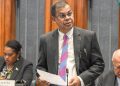
Turaga — whose first name, title and portfolio FBC News does not give, and which this report has not independently confirmed — told the House the proposed Bill of Rights would make it harder for the State to restrict individual rights. Any limitation, he said, would have to be “lawful, reasonable, justified and necessary in a free and democratic society,” wording he presented as a tighter threshold than the current arrangement. He said the proposed Constitution would strengthen rights, accountability and the independence of key state institutions.
On FICAC, Turaga argued that removal would cut duplication and clarify institutional responsibilities, with Police investigating and the ODPP prosecuting.
Tourism Minister Viliame Gavoka framed the Bill as a question of balance, saying the framework must weigh development against the protection of land, natural resources, culture and communities. He said Fiji’s tourism industry depends on its beaches, reefs, forests and cultural heritage, that major developments should involve the communities they affect, and that he supported the proposed 55-member House and its mix of constituency and party-list seats.
What the opposition is questioning
Leader of the Opposition Inia Seruiratu said constitutional reform has to secure broad public ownership and equal citizenship, arguing that Fiji’s diversity must be recognised without creating different standards for different citizens. He questioned whether a 23-member appointed Senate would provide enough of a check on executive power, and said constitutional authority must rest on strong institutions rather than on the personalities who happen to hold public office at the time.
Kumar’s objections were more specific. She challenged the removal of the national referendum requirement, arguing that constitutional decision-making should not sit entirely with Parliament — a point that lands differently in a country that only recently legislated on Fiji’s referendum law, including provision for overseas voters.
Christianity, chastisement and the chiefs
Kumar also questioned the proposed recognition of Christianity and family values, and a provision allowing lawful and moderate chastisement of children. She queried the role the Bill gives the Bose Levu Vakaturaga, the Great Council of Chiefs, in key appointments. The council’s statutory footing was fast-tracked earlier this year, and chiefly voices in the reform debate have already argued for it to be written into the national framework.
What this report cannot confirm
FBC News paraphrases most of what MPs said; the limitations test quoted above is the only wording it reports verbatim, which is why the contributions of Seruiratu, Kumar and Gavoka appear here as summary rather than direct speech. Their remarks have not been checked against the Hansard record or a second outlet, and no other newsroom’s account of the session was available when this was written.
The broadcaster reports no vote, no timetable for the remaining stages and no majority threshold for passage, and does not say whether the government has the numbers or how many MPs have spoken. It also leaves open how the maritime constituencies would be drawn and how, or by whom, the 23 senators would be appointed — the gap Seruiratu pointed to in asking whether that chamber would function as a check at all. Bills and proceedings are published by the Parliament of Fiji, which remains the primary record against which these claims should be tested.
Where it goes next
Second reading is the stage at which MPs debate the principle of a bill after its first reading, and FBC News reports only that the Bill reached it a day after introduction, with debate live as the broadcaster published. For readers in Fiji and the diaspora, the referendum requirement and the future home of corruption cases turn on how the remaining stages are resolved.
Frequently Asked Questions
Has the Constitution Amendment Bill 2026 passed?
No. FBC News reported the Bill still in second-reading debate on 2 October 2026 and reported no vote, so it had not completed its passage when the broadcaster published.
What happens to FICAC’s existing cases if the commission is removed?
FBC News does not say. Its report sets out only that corruption investigations would move to Police and prosecutions to the Office of the Director of Public Prosecutions, without addressing the commission’s current caseload, staff or files.
Where can I read the Bill text and the debate record?
Bills and the Hansard record of proceedings are published by the Parliament of Fiji. FBC News did not publish the wording of the clauses MPs were debating, including those on Christianity, family values and chastisement.
Which MPs does the FBC News report name?
Four: Turaga, for whom the broadcaster gives no first name, title or portfolio; Tourism Minister Viliame Gavoka; Leader of the Opposition Inia Seruiratu; and opposition MP Premila Kumar.