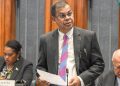
Fiji’s Minister for Health and Medical Services, Dr Atonio Lalabalavu, declared a national HIV emergency in an address on Tuesday 15 September 2026, saying an estimated one in every 60 adults in the country is now living with the virus. The declaration — reported by CNN, Yahoo News Australia and the International Business Times Australia, which said the minister announced it in a video statement on Facebook — escalates the “outbreak” classification Lalabalavu gave HIV in January 2025.
Key numbers
| Indicator | Earlier | Latest | Source |
|---|---|---|---|
| New HIV diagnoses | 147 (2020) | 2,016 (2025) | Telegraph, republished by Yahoo |
| HIV-related deaths | 25 (2021) | 117 (2025) | National health statistics via CNN |
| Prevalence | 1 in 167 people (five years ago) | 1 in 60 adults; 1 in 50 pregnant women | Lalabalavu via Yahoo News Australia |
| People living with HIV | — | about 9,100 (2025) | UNAIDS via CNN |
| Know their status | — | 39% | UNAIDS via CNN |
| On antiretroviral treatment | global average 78% | 22% in Fiji | UNAIDS via CNN |
One caution on the prevalence row: the current estimate is expressed per adult, while the earlier one Lalabalavu cited is per person across the whole population. Because children are included in the second denominator but not the first, the two figures are not strictly like-for-like, and the true rise in adult prevalence is therefore steeper than a straight 167-to-60 reading suggests.
Why it matters
Fiji is moving in the opposite direction to the rest of the world. Renata Ram, UNAIDS’ Fiji adviser, told CNN that new HIV infections globally fell by an estimated 42% between 2010 and 2025, while “Fiji has experienced an extraordinary increase over essentially the same period.”
UNAIDS executive director Winnie Byanyima called Fiji’s emergency a stark reminder to the world that AIDS is not over, the International Business Times Australia reported. Lalabalavu said the ministry cannot meet the challenge alone and that an outbreak-level response is no longer sufficient; emergency status obliges agencies across government to coordinate with the health ministry rather than leaving HIV to health authorities.
What it costs
The January 2025 outbreak declaration mobilised FJ$10m and created a national HIV taskforce, the Telegraph reported. That remains the only figure the government has publicly attached to its response, and it predates the commitments announced with the emergency — free testing, lifelong treatment for a caseload in which fewer than a quarter of patients are currently on antiretrovirals, and a needle and syringe programme. None of the outlets reviewed put a number on the wider economic exposure, whether to the health budget, the working-age labour force or Fiji’s tourism reputation; CNN reported only that methamphetamine spilling into local communities is straining the health system.
A drug epidemic feeding a virus
CNN reported that Fiji has seen a surge in intravenous drug use as the islands have emerged as a transit point for narcotics trafficked from the Americas to Australia, New Zealand and parts of Asia — a route the Telegraph called the “drugs superhighway.” Methamphetamine smuggled in by cartels has spilled into local communities.
Eamonn Murphy, UNAIDS’ Asia-Pacific director, told the Telegraph it is “a clash of two epidemics,” saying injecting drug use turned a small epidemic into an explosive one. Murphy put the increase at twelve-fold in 12 years; the International Business Times Australia, citing UNAIDS, said new infections rose twelvefold over 15 years. Both trace to the same UNAIDS estimate, so what differs is the baseline year chosen, not the scale: on either reckoning infections are roughly twelve times their starting level.
National health statistics cited by CNN show that in 2025, people who inject drugs made up roughly half of new cases where a transmission mode was identified, with the other half sexually transmitted. Ram said needle sharing is common, and that low condom use, multiple partners, limited testing and stigma all contribute. The Telegraph reported children as young as 10 have contracted the virus through injecting drugs. Clinicians treating the same methamphetamine supply chain elsewhere in the Pacific report worsening withdrawal cases, but Fiji has no comparable national data on meth withdrawal to measure its own treatment demand against. Separately, Fiji police are moving to centralise how drug exhibits are stored after cocaine went missing.
Mothers and newborns
Save the Children Fiji said this week that a two-month-old baby has become the youngest identified patient living with both HIV and tuberculosis, CNN reported, noting that HIV attacks the immune system and makes TB easier to contract. The organisation said 59 babies acquired HIV from their mothers last year; the Telegraph reported that 18 of them died before their first birthday.
The needle and syringe programme
Lalabalavu said Fiji will move quickly to expand testing, treatment and prophylaxis and will introduce a formal needle and syringe programme. The Telegraph reported that the scheme, which had hoped to launch at the start of the year, was delayed by politics, red tape and stigma in a largely Christian and conservative country, with critics claiming it would encourage drug use and an election due next year making it contentious.
Professor Lisa Maher, an epidemiologist at the Kirby Institute in Sydney supporting Fiji’s response, said the rollout has been slow and frustrating and that Fiji will pay for it in lives lost. A Cabinet subcommittee has been created to remove barriers, and Dr Jason Mitchell, head of Fiji’s HIV taskforce, told the Telegraph the programme is being fast-tracked. Fiji News has separately covered parliament legalising a needle exchange.
Stigma and distrust
Joeli Colati, executive director of Fiji Network Plus, a community organisation supporting people who are HIV positive, told CNN that HIV is connected to stigma, poverty, transport, confidentiality and fear, and that people may avoid care for fear of being recognised at an HIV clinic. Colati, who has lived with HIV for 19 years, said there is a major information gap about how the virus spreads and how effective treatment is.
Two men living with HIV in Suva, whom the Telegraph identified by the changed names Paulo and Ben, said stigma is worsening and they feel excluded from discussions with officials. Paulo shared Facebook comments urging the government to send HIV-positive people to Nukulau, an empty island formerly used as a prison. Lalabalavu urged Fijians not to shame, exclude or threaten anyone over their status.
Regional picture
Papua New Guinea declared its own national HIV crisis in June 2025 and has the highest and fastest-growing case numbers in the Pacific, the International Business Times Australia reported, while rates elsewhere in the region have generally remained low. Murphy said he is concerned about rising infections in other countries, including the Solomon Islands, given Fiji’s role as a gateway to the Pacific, and expects the outbreak to worsen before it improves.
Frequently Asked Questions
Is HIV testing and treatment free in Fiji under the emergency?
The International Business Times Australia reported that the government said it is expanding access to free HIV testing and free treatment for anyone who tests positive. Officials told the outlet that stigma remains a significant obstacle to getting more people tested and into care.
What is PrEP, and when did Fiji start offering it?
Yahoo News Australia described PrEP as pre-exposure prophylaxis, a daily pill or twice-yearly injection proven to reduce HIV transmission by 99%, and said Lalabalavu will expand access to it. The Telegraph, republished by Yahoo, reported that the prophylaxis scheme was introduced in May but labelled it post-exposure prophylaxis. These are not two names for one thing: pre-exposure prophylaxis is taken continuously by people at ongoing risk, while post-exposure prophylaxis is a short emergency course started within days of a single suspected exposure, so the discrepancy changes what the scheme actually offers and to whom. Neither outlet corrected the other.
Are the rising case numbers partly a result of more testing?
Lalabalavu said part of the apparent rise reflects expanded testing reaching more of the population than in previous years, rather than new infections alone, according to the International Business Times Australia. CNN reported that Fiji ramped up testing after first declaring an outbreak in January 2025, which revealed the scale of the crisis.
What did the World Health Organization find about Fiji’s outbreak?
Yahoo News Australia reported that in February the WHO said nearly half of those who started HIV treatment in Fiji in 2024 were injecting drugs. The same WHO data put new cases at 1,583 in 2024 and 1,226 in the first six months of 2025, and warned of urgent gaps in prevention and stigma-free care.