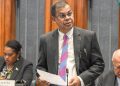
Deputy Prime Minister Manoa Kamikamica said on 22 September that it is too early to determine whether Fiji’s next general election could be affected by the constitutional reform process, speaking after the Constitutional Review Commission’s report was tabled in Parliament the same day.
Asked directly whether the election could be delayed if the constitutional process takes longer than expected, Kamikamica did not rule it out, according to FBC News, which reported his remarks after the tabling.
Key facts
- The Constitutional Review Commission’s report was tabled in Parliament on 22 September.
- Kamikamica said the Commission completed its work after six months.
- Cabinet was sitting on the day of the tabling to consider the report, he told reporters.
- A Bill is to be brought to Parliament next week for debate, he said.
- About 30 days of further public consultation are to follow the parliamentary debate.
- Kamikamica said Fiji has not yet reached the referendum stage.
- Deputy Prime Minister and SODELPA leader Viliame Gavoka said the Government believes it can build support through dialogue.
- Sections 159 and 160 of the 2013 Constitution — the document the reform would replace — require a three-quarters majority in Parliament and then approval by three-quarters of registered voters at a referendum.
- All quoted remarks above were reported by FBC News. No Opposition, Elections Office or civil-society reaction had been published at the time of writing.
Why it matters
The tabling puts two questions in front of voters at once: what a new Constitution would contain, and when they will next go to the polls. Kamikamica told reporters the Coalition Government still has several stages to complete — Cabinet consideration, parliamentary debate and roughly 30 days of further public consultation — before any referendum.
He stopped short of confirming a specific election date or ruling out any change to the timetable. Fiji News has previously reported on Prime Minister Sitiveni Rabuka’s stated timeline for a new Constitution, and Kamikamica referred back to Rabuka’s earlier statements that the election would be held within the constitutional period.
Pressed on whether he would support an election held beyond the constitutional timeframe if more time were needed to finish the reform work, Kamikamica did not answer directly, in comments carried by FBC News. He said instead that the Government’s immediate focus should be on the constitutional process now before it.
“At this stage, we need to allow a new process to start,” he said.
That framing — reform first, timetable later — has so far gone unanswered in public. The account of the day belongs to two coalition ministers. No member of the Opposition benches, no official of the Fijian Elections Office and no constitutional lawyer has been quoted on whether a delay is legally available, or on what would happen if the reform process ran past the end of Parliament’s term. Fiji News had not obtained comment from any of those parties at the time of publication and will report their responses when they are given.
The arithmetic behind the process
Neither Kamikamica nor Gavoka addressed the numerical thresholds in the remarks FBC News reported. Those numbers are set out in the text of the document they are seeking to replace, and they explain why the process is slow. The calculations that follow are Fiji News’s own, drawn from the published constitutional text and the official 2022 election result rather than from any statement by the Government.
Section 159 of the 2013 Constitution provides that a Bill to alter the Constitution must be supported by at least three-quarters of the members of Parliament. Section 160 provides that it must then be approved by at least three-quarters of registered voters at a referendum. The Parliament of Fiji has 55 seats, so the parliamentary threshold works out at 42 votes — 13 above a simple majority of 28.
Read literally, the second threshold is the harder of the two, because it counts registered voters rather than votes cast. On that reading, turnout below three-quarters would itself defeat a referendum regardless of how people voted. Fiji News has not obtained an authoritative legal interpretation of that provision, and no official has publicly addressed it in the current process.
The parliamentary threshold is the backdrop to Kamikamica’s explanation of the delay. The coalition took office in December 2022 holding 29 of the 55 seats won at that election — the People’s Alliance, the National Federation Party and SODELPA — against FijiFirst’s 26. On those numbers the Government was 13 votes short of the bar for constitutional change. Kamikamica said the numbers had since changed; he did not give a current count, and FBC News’s report did not supply one. Party standings in the House have shifted since 2022, and Fiji News has not independently confirmed the present figures.
The referendum threshold is untested. No referendum has been held under the 2013 Constitution, which was promulgated in September 2013 and first used for an election in September 2014.
When the election is due
Under section 58 of the 2013 Constitution, Parliament’s term runs for four years from the date of its first sitting. The current Parliament first sat in December 2022, following the general election of 14 December that year, which places the end of the term in late 2026 on the face of the text. The same section provides for Parliament to be dissolved earlier, but not, in its terms, for the four-year term to be extended.
Kamikamica did not tie the reform timetable to that date, nor did he identify any provision that would allow polling to be pushed beyond it. He pointed only to Rabuka’s earlier undertaking that the election would be held within the constitutional period, and said further announcements on the schedule were for the Prime Minister to make. That leaves the question raised by the headline — whether a delay is even legally possible — unanswered by anyone who has spoken publicly so far.
Six months of work, or decades?
Kamikamica pushed back on the idea that the proposed Constitution is the product of a short exercise. While the Commission completed its work after six months, he argued the document before Parliament draws on Fiji’s earlier constitutional arrangements and on review work already carried out.
He listed five reference points: the 1970 Constitution adopted at independence, the 1990 Constitution, the 1997 Constitution, the Yash Ghai Commission report and the 2013 Constitution — a span of 43 years. On that basis, he said, the six-month review should be viewed in the context of the wider constitutional history rather than judged on its own duration.
The Ghai Commission is the closest precedent for the current exercise, and it is a cautionary one. Its draft, produced in 2012 after a national consultation, was set aside and never enacted; the 2013 Constitution was issued instead, without a referendum and without passage through an elected Parliament. That outcome is part of why the sequencing announced this week — Cabinet, Bill, consultation, referendum — is being watched closely, and why Kamikamica’s appeal to continuity is contestable: two of the five documents he cited were themselves promulgated rather than voted through.
Gavoka: dialogue will win support
Gavoka, who is Deputy Prime Minister and leads SODELPA, struck a more confident note on the politics of the reform. He said a great deal of dialogue would take place in the days after the tabling, and that the Government believes it can convince everyone that this is the direction the country needs to take, FBC News reported.
Gavoka said constitutional reform had been part of Fiji’s national dialogue since 2013. He described the 2013 constitutional process as a rushed exercise that was imposed on the country, and said the current consultation process had been more inclusive. People across Fiji had been allowed to participate, he said, and the resulting document reflects what people wanted the country to be.
Neither minister gave a figure for how many submissions the Commission received, how many venues it visited or which groups appeared before it — the kind of detail that would allow the inclusiveness claim to be tested. No submission count appears in FBC News’s report, and the Commission’s own report had not been published in full when the two men spoke.
What is not yet confirmed
The Bill’s text has not been circulated publicly. No date has been set for the parliamentary debate beyond “next week”, no rules have been published for the 30-day consultation, and no referendum date has been proposed.
This account rests on FBC News’s reporting of the 22 September remarks by Kamikamica and Gavoka, together with the text of the 2013 Constitution and the published record of Fiji’s 2022 election result. Fiji News has not independently verified FBC News’s quotations, and no Government or Parliament of Fiji statement setting out the same timetable was available at the time of writing. The one voice missing from the record is anyone outside the coalition. This report will be updated when the Commission’s report, the Bill, an official timetable or a response from the Opposition, the Elections Office or constitutional law practitioners becomes available.
Frequently Asked Questions
How long will the next round of public consultation on the proposed Constitution last?
Kamikamica said there would be about 30 days of further consultation with the people of Fiji before the Government moves to the next stage, in comments carried by FBC News on 22 September. That consultation period would follow the parliamentary debate on the Bill and precede any move towards a referendum. He did not say how those 30 days would be run, who would run them or how submissions would be collected, and no Government document setting out the mechanics was public at the time of writing.
What majority does Fiji’s 2013 Constitution require to change it?
The text of the 2013 Constitution sets two thresholds. Section 159 requires that a Bill to alter the Constitution be supported by at least three-quarters of the members of Parliament. Section 160 requires that it then be approved by at least three-quarters of registered voters at a referendum. Parliament has 55 seats, so three-quarters of members is 42 votes — a figure Fiji News calculated from the seat total, not one quoted by any official. Kamikamica did not address either threshold in the remarks FBC News published.
Why did the coalition wait before starting the constitutional review?
Kamikamica told reporters the coalition Government had taken time to begin the review after coming into office because it initially did not have the numbers in Parliament, and that this had since changed, FBC News reported. Published results from the December 2022 general election show the coalition parties — the People’s Alliance, the National Federation Party and SODELPA — won 29 of the 55 seats between them, against FijiFirst’s 26. On those figures the coalition was 13 votes short of 42. Kamikamica did not give a current count, and Fiji News could not independently confirm present party standings in the House.
Who will announce the date of Fiji’s next general election?
Kamikamica said he would leave any further announcement on the election schedule to the Prime Minister, according to FBC News. He pointed to previous statements by Prime Minister Sitiveni Rabuka that the election would be held within the constitutional period, without confirming a date. Under section 58 of the 2013 Constitution, Parliament’s term runs for four years from the date of its first sitting; the current Parliament first sat in December 2022. The writ and polling date are issued under the Constitution and administered by the Fijian Elections Office.
Can Fiji’s next election legally be delayed because of constitutional reform?
Neither Kamikamica nor Deputy Prime Minister Viliame Gavoka set out any legal mechanism for a delay in the remarks FBC News reported, and Kamikamica did not answer directly when asked whether he would support an election held beyond the constitutional timeframe. The 2013 Constitution fixes Parliament’s term at four years from its first sitting in section 58 and does not, on its face, provide for that term to be extended to accommodate a referendum. Fiji News had not obtained comment from the Fijian Elections Office, the Opposition or an independent constitutional lawyer at the time of publication, and this question remains untested in public.
Which earlier constitutional documents did Kamikamica say fed into the proposed Constitution?
He pointed to Fiji’s 1970 and 1990 Constitutions, the 1997 Constitution, the Yash Ghai Commission report and the 2013 Constitution, according to FBC News — five documents spanning 43 years. Kamikamica argued the document now before Parliament was not the product of the Commission’s six months of work alone. The Ghai Commission’s 2012 draft was set aside and never enacted; the 2013 Constitution was promulgated in its place.