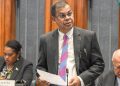
A paramount chief of Lau Province, Ratu Tevita Mara, has publicly urged Fiji’s Parliament not to approve the two major bilateral agreements signed with Australia in Suva on 6 July 2026. In a media statement reported on 22 September by RNZ, he asked lawmakers to withhold approval until Fijians are given what he called a full, fearless and independent account of what the treaties commit the country to.
Neither the Fijian government nor the Australian government has publicly answered him in the reporting available so far. RNZ’s account and the version carried by Asia Pacific Report contain no comment from the Office of the Prime Minister in Suva, from the Standing Committee handling the texts, or from Canberra. That silence is itself part of the story: the two agreements have been presented by both governments as a landmark, and the most senior traditional voice to question the process has so far gone unanswered on the record.
Key facts
- The two agreements are the Vuvale Union and the Ocean of Peace Alliance, also called the Veitacini Treaty.
- They were signed in Suva on 6 July 2026 by the Fijian and Australian prime ministers, RNZ reports.
- Both are now before Parliament’s Standing Committee on Foreign Affairs and Defence.
- Ratu Tevita Mara says that under the 2013 Constitution, neither agreement binds Fiji until Parliament approves it.
- He is calling on the Great Council of Chiefs, the Bose Levu Vakaturaga, to meet and discuss the matter.
- No response from either government is recorded in either report.
What the two agreements cover
RNZ describes the Vuvale Union as a broad political and economic framework. The Ocean of Peace Alliance, or Veitacini Treaty, is the specific defence and security pillar sitting inside that wider strategic partnership.
Fiji and Australia say the package will strengthen cooperation on security, economic development, climate resilience and regional stability, RNZ reports. Both governments have called the agreements significant for the future of the relationship. Australian Prime Minister Anthony Albanese said the signing was “one of the most significant endeavours” Australia had undertaken with any country, according to RNZ.
Neither source sets out the individual clauses of either text. That matters for readers trying to judge the chief’s case on its merits: the specific commitments he wants examined — on defence, on basing, on economic cooperation — are not in the public reporting, because the full texts have not been published by either outlet.
What the chief is asking for
Ratu Tevita’s request is procedural rather than a demand for rejection. He said the parliamentary examination needs sufficient time, independent advice and public participation before any vote is taken.
He was explicit that he is not turning on Canberra. “Let me be clear: this is not a rejection of Australia. It is a defence of Fiji,” he said in the statement reported by RNZ. He described Australia as a valued friend, while warning that an arrangement presented in the language of family and cooperation still has to be read line by line.
His statement also carries a warning about terms whose deeper consequences only become apparent after Fiji is bound, and the lines that both outlets highlighted: friendship must never require blindness, cooperation must never become subordination, and no government has the right to gamble with the sovereignty of future generations.
Why it matters
The weight of the intervention comes from who is making it and where the decision now sits. RNZ describes Ratu Tevita Mara as one of Fiji’s most prominent traditional and political figures, a paramount chief of Lau and a deputy chair of the Great Council of Chiefs. He is asking MPs to withhold approval of agreements an Australian prime minister has called one of the most significant his country has undertaken with anyone.
His case rests on a constitutional claim: he says that under the 2013 Constitution neither agreement binds Fiji until Parliament approves it. On that reading, the signatures exchanged in Suva in July did not finish the job, and the committee stage is where the detail is either tested or waved through.
He also frames the window as narrow. Ratu Tevita argued that ratification is close to irreversible and told media this was the moment — “the last moment” — for Fiji to examine the agreements properly, according to RNZ. That characterisation of the point of no return is his own; neither government is reported as describing the process in those terms, and neither outlet independently assesses how reversible ratification would be.
His statement lands while efforts to replace the 2013 Constitution are already a live political argument at home — the same 2013 document his objection is built on.
The economic stakes behind the security headline
The defence and security pillar has taken the headlines, but economic development is one of the four areas RNZ reports the two governments say the agreements will strengthen, alongside security, climate resilience and regional stability. Neither RNZ nor Asia Pacific Report quantifies that economic content or lists trade, investment or labour mobility provisions, so the commercial shape of the Vuvale Union remains unpublished.
What is already measurable is how much of Fiji’s economy runs through the Australian relationship the treaties formalise. Australia is one of the country’s largest source markets for visitors, and this site has previously reported the money Australian visitors spend here at $3.7 billion — earnings that flow into hotels, transport, tour operators and the wage bills behind them. The same relationship also shapes Fiji’s regional posture, including Fiji’s diplomatic push at the United Nations on climate.
Ratu Tevita does not dispute the value of that relationship — he calls Australia a valued friend — and neither report links his objection to any economic clause. But the scale of the existing trade and tourism ties is the backdrop against which MPs will weigh a call to slow down.
Where it goes next
With both agreements sitting with the Standing Committee on Foreign Affairs and Defence, the committee’s handling of them is the immediate test of the chief’s call for time, independent advice and public input. He has separately asked the Great Council of Chiefs to convene on the question.
Neither source reports a date for such a meeting, nor a timetable for the committee’s work or a parliamentary vote. Nor does either report say whether the committee intends to call for public submissions on the texts. Those are the next things worth watching, along with any response from the Fijian or Australian governments.
About the sourcing
This report is based on RNZ’s account of Ratu Tevita Mara’s media statement of 22 September, and the same report carried by Asia Pacific Report. The two versions do not differ on any of the facts above; readers should note that Asia Pacific Report is carrying RNZ’s reporting rather than independently confirming it, so this account rests on a single original source.
Limits of that sourcing, stated plainly: neither outlet publishes the full text of the Vuvale Union or the Veitacini Treaty; neither names the other signatories present in Suva beyond the two prime ministers; neither carries a response from the Fijian government, the Australian government or a member of the Standing Committee; and neither quotes an independent constitutional lawyer on the chief’s reading of the 2013 Constitution. The $3.7 billion Australian visitor spend figure comes from this site’s own earlier reporting, not from RNZ. This article will be updated if either government responds.
Frequently Asked Questions
Who is Ratu Tevita Mara?
RNZ describes Ratu Tevita Mara as one of Fiji’s most prominent traditional and political figures and a paramount chief of Lau Province. He is also one of the deputy chairs of the Great Council of Chiefs, the Bose Levu Vakaturaga — the body he has separately asked to convene and discuss the two agreements with Australia.
What are the Vuvale Union and the Veitacini Treaty?
They are the two bilateral agreements Fiji and Australia signed in Suva on 6 July 2026, according to RNZ. RNZ describes the Vuvale Union as the broad political and economic framework, and the Ocean of Peace Alliance — also called the Veitacini Treaty — as the defence and security pillar sitting inside that wider strategic partnership. Neither RNZ nor Asia Pacific Report publishes the full text of either agreement.
Has Fiji already committed to the agreements?
Not according to Ratu Tevita Mara’s reading of the 2013 Constitution, which he says means neither agreement binds Fiji until Parliament approves it. Both are currently before Parliament’s Standing Committee on Foreign Affairs and Defence, RNZ reports. Neither outlet gives a timetable for the committee’s work or for any parliamentary vote.
Is the chief asking Fiji to walk away from Australia?
No. He told media his call is “not a rejection of Australia” but “a defence of Fiji”, and described Australia as a valued friend, according to RNZ and Asia Pacific Report. His argument is procedural: that the texts must be examined with enough time, independent advice and public participation before Parliament binds the country.
What did Australian Prime Minister Anthony Albanese say about the agreements?
RNZ reports that Albanese said signing the agreements was “one of the most significant endeavours” Australia had undertaken with any country. Both governments have described the agreements as significant for the future of Fiji-Australia relations. Neither source reports any response from Albanese or from Canberra to the chief’s statement.
What is economically at stake in the Fiji-Australia relationship?
RNZ reports that the two governments say the agreements will strengthen cooperation on economic development alongside security, climate resilience and regional stability, but neither RNZ nor Asia Pacific Report sets out the economic clauses. Separately, Australia is one of Fiji’s largest visitor markets: this site has previously reported Fiji earning $3.7 billion from Australian tourists.
Have the Fijian or Australian governments responded to the chief?
Not in the reporting available at the time of writing. Neither RNZ’s report of 22 September nor the Asia Pacific Report version carries a comment from the Fijian government, the Office of the Prime Minister, the Standing Committee or the Australian government responding to Ratu Tevita Mara’s statement.