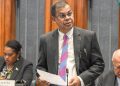
Fiji is developing standards to improve safety and support the country’s transition to affordable and clean energy, Deputy Prime Minister and Minister for Industries, Commerce and Business Development Manoa Kamikamica said at World Standards Day events on 12 October, tying the work to Fiji’s commitments under United Nations Sustainable Development Goal 7 (SDG 7). The standards are being drawn up in consultation with stakeholders through the Department of National Trade Measurement and Standards (DNTMS), according to the Fiji Sun.
Key facts
- Kamikamica said standards could help ensure household electrical appliances are safe and that renewable energy systems perform as promised, the Fiji Sun reported.
- The ministry is also developing a national standardisation strategy to align international and national standards with Fiji’s social and economic needs.
- Separately, a World Bank Group report ranks electricity access alongside renewable energy as a regional priority, Islands Business reported.
Why it matters
Access to affordable, reliable and sustainable energy remains a national priority as Fiji faces the challenges of climate change and seeks to reduce its reliance on imported fossil fuels, Kamikamica said, according to the Fiji Sun. The paper quoted him as saying: “Standards are one of the practical tools that turn ambition into something that people can rely on.”
Fit for Fiji, not just copied
International standards have to be adapted to local conditions rather than adopted wholesale, Kamikamica said, the Fiji Sun reported — the stated purpose of the national standardisation strategy now being prepared alongside the energy-related standards.
Standards are also becoming more important as Fiji adopts new technologies, including artificial intelligence, which Kamikamica said raised questions about transparency, accountability, security and public trust, the Fiji Sun reported. Fiji is one of six Pacific island countries in a project on the responsible adoption of AI, led by Standards Australia with the Commonwealth Scientific and Industrial Research Organisation (CSIRO) and Ethical AI Consulting, funded by the Australian Government.
The regional access gap
Islands Business’s editorial draws on the World Bank Group report Toward a Secure, Affordable, and Resilient Energy Future: Roadmaps for the Pacific Islands, which finds that about 41 per cent of the combined population across Fiji, the Federated States of Micronesia, Papua New Guinea, the Solomon Islands and Tonga lacks access to electricity services.
That average hides a wide spread. Most of the people without access live in Papua New Guinea, the Solomon Islands and Chuuk, the outlet reports. Papua New Guinea’s access rate stood at just over 21 per cent in 2023, against a 70 per cent target for 2030; Tonga has reached 100 per cent and Fiji 99 per cent. National figures do not erase rural and outer-island gaps — the same gaps behind UNDP’s plan to target 399 Fiji villages for solar electrification.
The barrier is not a lack of ambition, Islands Business writes. Geography makes conventional grid expansion costly: the Pacific Island Countries comprise around 1,000 islands spread across 180 million square kilometres of ocean, with small, remote populations, high infrastructure costs and limited economies of scale. Off-grid solutions face their own affordability, maintenance and climate-resilience challenges.
Utilities and money
The report identifies weak utility finances, limited institutional capacity and insufficient investment as barriers, according to Islands Business. Tariffs that fail to cover the costs of efficient service delivery can undermine utility sustainability, while irregular adjustments and delayed public-sector payments add pressure. Expanding access without addressing those constraints risks leaving infrastructure without the resources needed to maintain it.
The five countries need an estimated $2 billion through 2030 for generation, resilient grids, storage and electricity access, Islands Business reports, citing the roadmaps. The figure is published as a bare dollar sign: the editorial does not say whether it is US or Fiji dollars, give a start year for the window, or break the total down by country. World Bank regional investment estimates are conventionally stated in US dollars, but Islands Business does not say so, so the gap is one of reporting detail rather than a dispute about the number, and the roadmaps themselves are the only place to confirm the basis.
Analysis: standards sit on the cost side of the access problem
The two announcements are usually read separately, but they meet on the same ledger. The $2 billion estimate buys hardware, and the report’s own warning is that thinly financed utilities struggle to keep that hardware running. Standards act earlier and cheaper: they set the terms on which imported appliances and solar equipment may be sold, which in turn shapes how long a donor-funded system survives in a humid, cyclone-exposed environment and how much of a household’s energy spending goes on replacements rather than power.
Read that way — and this is editorial framing rather than a claim either outlet makes — the standards work looks as much like trade and consumer-cost policy as energy policy in an economy that imports almost all of its appliances and fuel, and like the one lever Fiji can pull without waiting for external concessional capital.
The open variable is specificity. Neither outlet reports which standards are being drafted, what they will cost to administer and enforce, or when they are due — the details that decide whether the regime bites or becomes paperwork.
Background
Fiji’s energy, climate and trade agenda has produced several parallel workstreams this year, including an FJD$5.2 million plan targeting Fiji’s first carbon trade by 2030, which seeks to earn revenue from the same transition, and a pre-COP31 meeting at which Pacific leaders met in Nadi ahead of COP31. Islands Business argues success should be measured not by how much renewable generation is added, but by whether remote communities gain dependable electricity and whether utilities can sustain it.
Frequently Asked Questions
What is SDG 7, which the Fiji Government says it is working towards?
SDG 7 is the United Nations Sustainable Development Goal on affordable and clean energy, according to the Fiji Sun, which reported that Kamikamica described it as a national priority for Fiji.
What measures does the World Bank roadmap say would speed up electricity access?
The roadmaps identify targeted subsidies, off-grid concessions, and improved land and community engagement, Islands Business reports. They also advise matching each setting to the right option: grid densification where it can extend service, and mini-grids, stand-alone solar and other decentralised solutions where distance and cost make conventional expansion hard to justify.
Why does the report say concessional finance is still needed?
Concessional finance remains critical for rural electrification and other projects that are not yet commercially viable for private investors, according to the World Bank Group report as reported by Islands Business. It says funding should back practical, sequenced plans that link investment to stronger institutions and durable service.